


STEEL FIBER
REINFORCED CONCRETE
Steel Fiber Reinforced Concrete — SFRC — introduces distributed steel fibers throughout the concrete matrix to improve post-cracking behavior, toughness and resistance to demanding floor conditions. RAM ARBIA integrates steel fiber technology into industrial concrete flooring systems around the structural and operational requirements of each project.
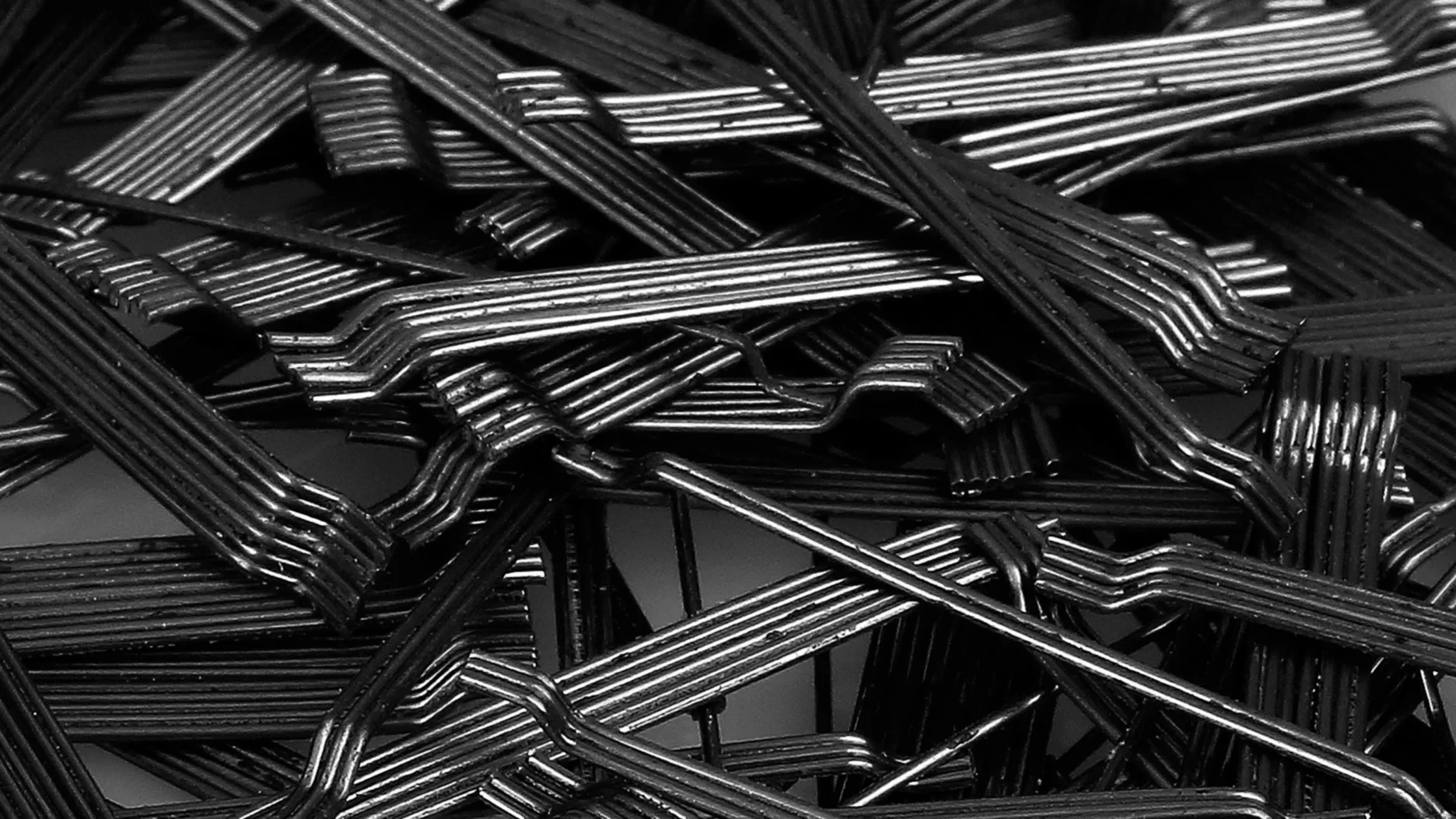
Strength distributed
through the concrete.
Conventional reinforcement concentrates steel within defined layers or positions. Steel fiber technology introduces many short reinforcement elements throughout the concrete mix, creating reinforcement across the slab volume.
RAM ARBIA integrates steel fibers into concrete flooring as part of the complete floor system — considering loading, concrete mix, slab design, joint strategy, placement, finishing and long-term operational use.
Concrete carries the load.
Fibers help control the response.
Steel fibers become distributed reinforcement inside the hardened concrete. Their contribution becomes particularly relevant as microcracks develop and stresses redistribute through the slab.
Fibers crossing developing cracks can continue transferring forces through the concrete matrix.
Distributed reinforcement supports improved post-cracking behavior.
Steel fiber reinforcement can support floors exposed to demanding operational use.
Fibers become dispersed throughout the concrete rather than concentrated at one reinforcement layer.
Reinforcement strategy contributes to long-term slab performance when properly designed.
Steel fibers work as part of the complete slab design rather than as an isolated material.
Fibers work where
the concrete begins to crack.
Steel fibers are mixed throughout the concrete. As cracking begins, fibers that cross the crack can resist pull-out and continue transferring forces between the two sides of the concrete.
Fiber performance depends
on the complete concrete mix.
Steel fiber cannot be evaluated independently from the concrete in which it is used. Fiber geometry, dosage, concrete properties, mixing, placement and slab design must be considered as parts of one engineered system.
Shape, length and anchorage characteristics influence how fibers interact with concrete.
Concrete properties must support proper fiber distribution and floor execution.
Fiber quantity should be determined around structural and operational requirements.
Floor thickness, loading and reinforcement strategy remain part of the engineered slab.
Controlled mixing supports uniform distribution throughout the concrete.
Construction procedures influence the final quality of the reinforced floor.
More fiber is not
automatically better.
Steel fiber dosage should respond to the floor design rather than follow one universal value. The appropriate quantity depends on loading, concrete properties, slab geometry, fiber type and the required structural performance.
Reinforcement must reach
the entire concrete matrix.
Successful SFRC depends on achieving consistent fiber distribution without excessive clustering. Mixing and concrete handling therefore become important parts of the flooring process.
Steel fiber becomes part
of the slab strategy.
SFRC can be integrated into jointed and reduced-joint industrial floor systems. The reinforcement strategy should be coordinated with slab dimensions, loading, concrete behavior, joint locations and the intended use of the floor.
Reinforcement for demanding
concrete floor environments.
Steel fiber reinforced concrete can be considered where flooring must respond to concentrated loads, vehicle traffic, impact and intensive operational use.
Warehouses
Logistics Facilities
Industrial Facilities
Manufacturing Plants
Garages & Parking Areas
External Concrete Pavements
Select the reinforcement
around the floor.
SFRC should be evaluated as an engineered flooring system. Final reinforcement design depends on project-specific structural, operational and construction requirements.
From floor requirements
to reinforced concrete.
Steel fiber flooring should be coordinated from design through mixing and placement so the reinforcement system supports the intended performance of the completed slab.
Assess
Review floor loads, operation and performance requirements.
Design
Coordinate slab, reinforcement and joint strategy.
Select
Determine suitable fiber characteristics and dosage.
Mix
Introduce fibers through a controlled mixing process.
Place
Execute concrete placement and flooring application.
Finish
Complete finishing, curing and floor verification.
Reinforcement is only
as good as the system.
Steel fiber performance depends on correct engineering, concrete quality, fiber distribution, placement and the complete floor construction process.