


GLUED
STEEL FIBER
Glued steel fibers are bundled together using water-soluble adhesive to support controlled introduction and dispersion during concrete mixing. Once mixed, the bundles separate into individual hooked-end fibers that become distributed throughout the concrete matrix as part of an engineered steel fiber reinforced concrete system.
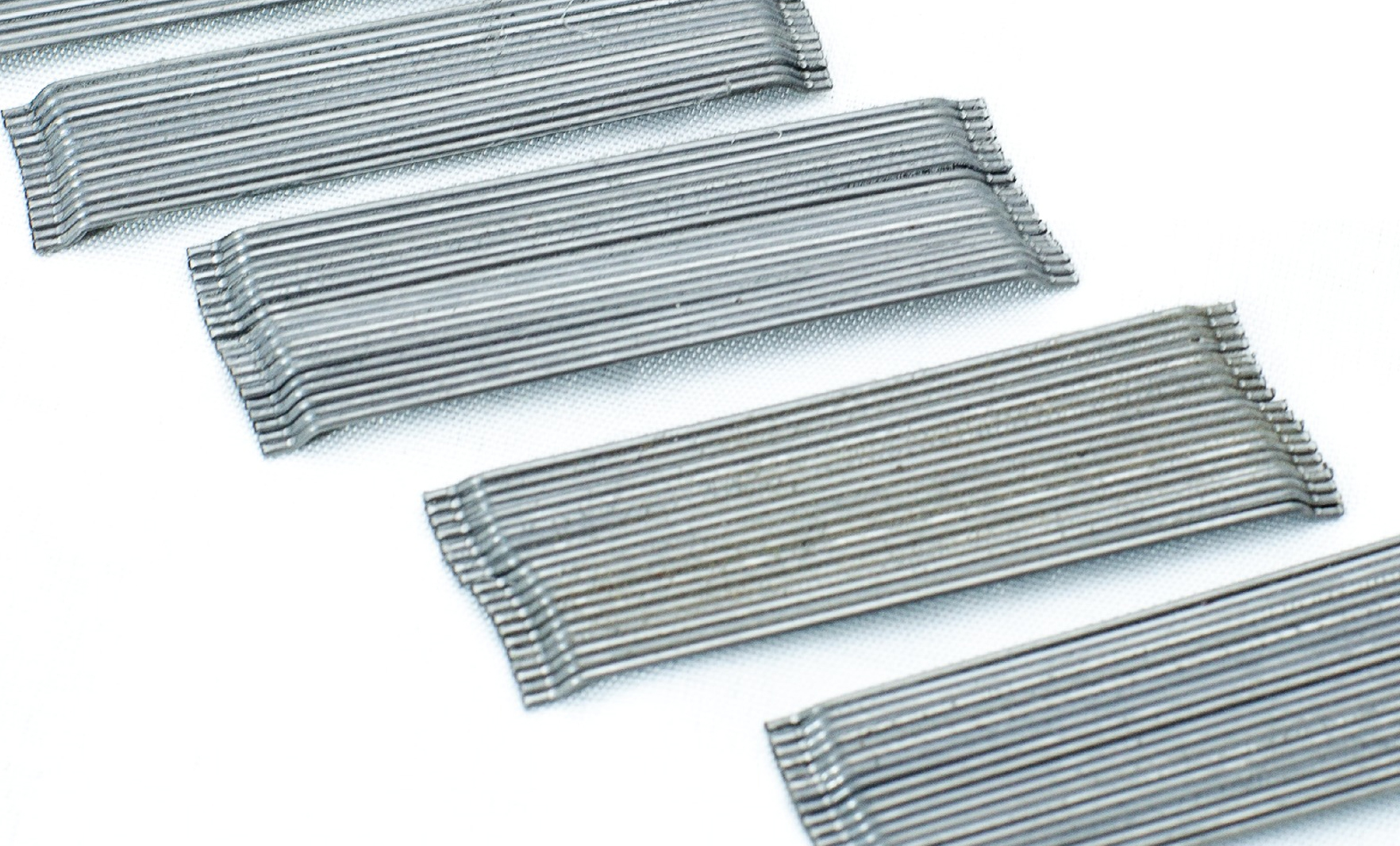
Bundled for handling.
Separated for performance.
Individual steel fibers can be difficult to introduce uniformly when large quantities are added to concrete. Glued steel fiber addresses the handling stage by temporarily combining multiple fibers into organized bundles.
During mixing, the water-soluble bonding material breaks down and the fibers separate. The objective is to support consistent distribution of individual fibers throughout the concrete while reducing the risk of fiber clustering.
Engineered around mixing,
distribution and anchorage.
Glued steel fiber combines temporary bundling with individual hooked-end fibers. Each feature serves a different stage of the concrete reinforcement process.
Individual fibers are temporarily grouped together for handling and introduction.
The bonding material is designed to separate during the concrete mixing process.
Deformed ends provide mechanical anchorage within the hardened concrete matrix.
Separated fibers become dispersed throughout the concrete volume.
Fiber geometry can vary according to product and project requirements.
Glued fibers operate as part of the complete reinforced concrete floor system.
From bundle
to distributed fiber.
The temporary bond keeps the fibers grouped before mixing. When the bundle enters the concrete mix, the water-soluble adhesive releases and the individual fibers separate progressively throughout the concrete.
Anchorage at both ends
supports crack bridging.
Hooked-end geometry increases mechanical interaction between the fiber and surrounding concrete. When a crack intersects a fiber, the deformed ends can resist pull-out and contribute to force transfer across the crack.
Fiber geometry should
match the application.
Glued steel fibers are available in different geometries. Final product selection should respond to the engineered performance requirements of the concrete element or flooring system.
Good dispersion begins
before concrete placement.
Glued fibers are intended to support controlled introduction into concrete, but final distribution still depends on suitable batching, mixing sequence, concrete workability and site procedures.
The fiber is one component
of the complete slab.
Glued steel fiber should be coordinated with the concrete mix, slab design, joint strategy, subgrade, operational loads and construction method. Product selection alone does not define final floor performance.
One product.
Multiple concrete applications.
Glued hooked-end steel fiber can be considered across different concrete applications where distributed reinforcement and controlled mixing are required.
Industrial Flooring
Warehouses & Logistics Floors
Concrete Pavements
Precast Concrete
Shotcrete Applications
Heavy-Duty Concrete Slabs
Designed to simplify
controlled fiber introduction.
The glued format primarily addresses handling and dispersion during concrete mixing. Its value should be considered together with fiber geometry and the overall SFRC design.
Temporary grouping simplifies handling before fibers enter the concrete mixer.
Water-soluble bonding supports separation during the mixing process.
Controlled introduction can help reduce localized fiber accumulation.
Fiber geometry supports mechanical interaction with hardened concrete.
Bundled fibers can support practical dosing into concrete production workflows.
Product can be integrated into engineered floor and concrete reinforcement strategies.
Select the fiber
around the concrete system.
Final fiber selection and dosage should be project-specific. Performance depends on the relationship between fiber characteristics, concrete, slab design and operational requirements.
From product selection
to reinforced concrete.
Glued steel fiber becomes effective only when product selection, dosing, mixing and placement are integrated with the engineered concrete system.
Assess
Review structural and operational requirements.
Select
Define appropriate fiber configuration and dosage.
Dose
Introduce fiber bundles through a controlled process.
Disperse
Allow bundles to separate during concrete mixing.
Place
Execute reinforced concrete placement and flooring works.
Verify
Review concrete consistency and completed floor quality.
Good fiber performance
starts with good dispersion.
Glued fiber simplifies one important part of SFRC construction, but final performance still depends on engineering, materials and execution.